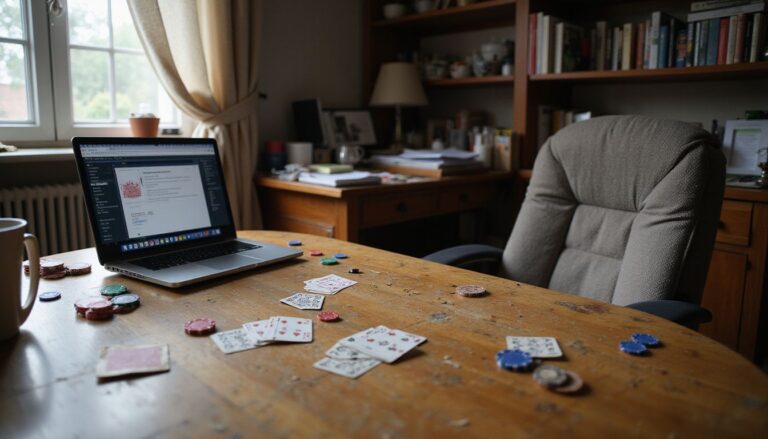
You sit at your favorite online poker table, and your pocket aces get cracked by a two-outer on the river for the third time this week. Poker variance affects every player, but low stakes grinders face unique emotional challenges because they play more hands and experience swings more frequently.
This guide teaches you practical strategies to manage tilt, handle downswings, and protect your mental state during tough sessions. Your poker survival depends on mastering these emotional skills.
Key Takeaways
- Poker variance creates emotional challenges for low stakes grinders who play more hands and experience swings more frequently than other players.
- Proper bankroll management with sufficient funds reduces scared money decisions and provides emotional stability during inevitable downswings and negative variance periods.
- Tilt destroys more poker bankrolls than bad luck, requiring players to recognize warning signs and implement stop-loss limits to protect profits.
- Long-term expected value thinking helps players focus on decision quality over short-term results, reducing emotional reactions to bad beats and coolers.
- Building support networks through poker communities and maintaining work-life balance creates resilience during tough stretches and prevents emotional burnout.
Understanding Variance and Downswings in Poker
Poker variance hits every player like a wild rollercoaster ride that never stops. Downswings crush your confidence and drain your bankroll faster than you think possible.
What is variance in poker?
Variance in poker represents the gap between what you expect to win and what you actually earn over short periods. This natural part of the game creates swings that can make your results look wildly different from your true skill level.
Bad players can beat good players in single sessions because luck dominates short-term outcomes. Your bankroll might drop $500 even when you play perfectly, or you might win $800 during a terrible session.
Poker variance affects every player regardless of skill level. The disparity between expected and actual earnings becomes more obvious in tournaments compared to cash games. Six-max games create more variance than full-ring formats because you play more hands per hour.
Variance makes poker profitable for casinos and keeps weaker players coming back. Without these natural swings, skilled players would crush every session and recreational players would quit immediately.
Understanding how downswings impact your emotions becomes crucial for long-term success.
How do downswings affect your emotions?
Understanding variance leads directly to experiencing its emotional impact through downswings. Downswings decrease performance and confidence, creating a cycle known as “Poker Hell.” Your mental states shift dramatically during these periods.
Negative variance triggers powerful emotional responses that cloud rational thinking. Players often feel punished despite making correct decisions at the table.
Downswings have long-lasting negative effects and are a statistical reality for all players. These losing streaks disrupt personal identity and a sense of progress, challenging self-narratives about poker skills.
Risk-aversion develops as motivation drops. Downswings can lead to learned helplessness, where players become overly cautious and lose their competitive drive. Your conscious mind struggles to process the disconnect between good play and poor results.
The orbitofrontal cortex, which handles decision-making, becomes overwhelmed by stress and frustration.
Why can’t low-stakes grinders avoid variance?
Downswings create emotional stress, but the root cause runs deeper than bad luck. Variance in poker exists because the game combines skill with chance in every hand.
Low-stakes grinders face an unavoidable truth about poker’s structure. Variance remains intrinsic to the game itself, making short-term results unpredictable regardless of skill level.
Even experienced players encounter losing streaks and negative variance periods that can last weeks or months. Skillful play helps reduce variance but cannot eliminate it entirely from your results.
The standard deviation of outcomes means that talented players still experience significant swings in their bankroll. My own experience grinding $1/$2 games taught me this lesson harshly during a brutal three-month downswing where solid play couldn’t overcome the mathematical reality of poker variance.
The Mental Game: Managing Tilt
Tilt destroys more poker bankrolls than bad luck ever will. Your emotional state directly controls your decision-making ability at the tables, and even small amounts of frustration can turn winning sessions into disasters.
How can I recognize the signs of tilt?
Tilt works like a pot of boiling water, with your emotional stability breaking down as negative experiences pile up. You might notice yourself making aggressive calls that you normally wouldn’t make, or bluffing in spots where value betting makes more sense.
Hot tilt shows up as impulsive, angry play where you chase losses and ignore bankroll management rules. Cold tilt appears as a detached, resigned state where you play mechanically without proper thought processes.
Many poker players become a “sleeping bear” when tilted, completely unaware their decision-making has deteriorated. You start ignoring basic poker strategy principles and make plays based on feelings rather than logic.
Your risk-averse nature disappears, and you begin taking unnecessary gambles in marginal situations. Physical signs include faster breathing, tense muscles, or feeling frustrated after losing pots that you played correctly but lost due to negative variance.
In what ways does tilt hurt my decisions and profits?
Tilt creates a dangerous cycle that destroys your poker strategy and bankroll. Emotional mistakes flood your decision-making process during tilted sessions. Your brain stops thinking rationally about pot odds and expected value.
Poor choices multiply as frustration builds from each lost hand. Players often chase losses with aggressive betting patterns that ignore solid poker fundamentals. Risk-seeking behavior takes over when you feel behind for the session.
Suboptimal play becomes your default mode instead of disciplined strategy.
Confidence drops with each bad decision, creating deeper performance issues. Losing streaks extend far beyond normal variance when tilt controls your actions. Reckless bets replace calculated value plays as emotions override logic.
Your risk aversion shifts dramatically based on emotional state rather than mathematical reasoning. Bankroll management rules get thrown out the window during heated moments. Extended downswings become inevitable when tilt prevents you from playing your A-game consistently.
What are common causes of tilt in poker?
Tilt triggers hit poker players in predictable ways. Losing big pots creates immediate frustration, especially after making correct decisions. Failed bluffs sting because they attack your poker strategy directly.
Players often feel insulted by opponents’ comments or playing styles. Physical factors like fatigue and hunger weaken emotional control during long sessions. External stressors from work or relationships carry over to the poker table.
Jared Tendler’s “The Mental Game of Poker” identifies six distinct tilt types that plague players. Injustice tilt strikes when bad beats feel unfair. Hate-losing tilt emerges from pure frustration with losing money.
Mistake tilt punishes you for errors in judgment. Entitlement tilt develops when you expect to win based on skill alone. Revenge tilt pushes risky plays against specific opponents.
Desperation tilt forces poor decisions when bankrolls shrink. Each type stems from reward conditioning and ego stability issues that affect your poker variance management.
Strategies to Emotionally Handle Variance
Variance hits every poker player hard, but smart grinders learn to handle the emotional rollercoaster that comes with bad beats and cold decks. You can train your mind to accept short-term losses while keeping your eyes on long-term profits.
The key lies in changing how you think about each hand and session. Want to discover the mental tricks that separate winning players from tilting fish?
How can I accept variance as part of poker?
Accepting variance in poker starts with understanding one simple truth: luck dictates short-term results while skill decides long-term success. Aspiring professionals must embrace this reality because variance is a permanent aspect of the game that cannot be eliminated.
The phrase “It’s all one long session” serves as a powerful mental framework that helps players view each hand, each night, and each month as part of one continuous journey. This mindset shift prevents you from getting caught up in daily swings and keeps your focus on the bigger picture.
Variance actually benefits the poker ecosystem by allowing weaker players to win occasionally, which keeps them coming back to the tables. Without these natural swings, recreational players would lose consistently and quit playing, making the games much tougher for everyone.
Managing expectations becomes crucial during downswings because understanding that bad runs are mathematically inevitable helps avoid frustration and tilt. Smart grinders learn to view variance as a business expense rather than personal punishment, knowing that their edge will show up over thousands of hands rather than hundreds.
Why should I focus on long-term expected value (EV)?
Long-term expected value (EV) serves as your true north star in poker strategy. Short-term results lie to you constantly. You might win big for three sessions straight while making terrible decisions.
You could also lose money for weeks while playing perfectly. EV graphs show the stark difference between your actual results and what you should have earned based on your decisions.
This process mindset protects you from becoming results-oriented and emotionally reactive to variance in poker.
Your skill level determines your long-term profit, not your recent session results. I’ve watched countless grinders abandon solid poker strategy after a few bad beats. They start chasing losses with reckless plays.
Smart players treat poker like a business. Wins become income, losses turn into expenses, and improving your game represents an investment in future profits. Expected value measures your true skill far better than your current bankroll.
Focus on making +EV decisions every hand, and the money follows naturally over thousands of sessions.
How do Sklansky dollars help change my perspective?
Sklansky dollars focus on expected value rather than actual outcomes in every poker decision. This concept helps you evaluate the correctness of your play based on mathematical advantage, not whether you won or lost the hand.
For example, getting all your chips in with pocket Aces against pocket Kings creates positive expected value, even if the Kings hit a set on the flop. Your decision was profitable in Sklansky dollars because you made the mathematically correct choice.
This framework transforms how you view poker variance and reduces emotional swings from bad beats. Instead of getting tilted after losing with a strong hand, you recognize that you made a +EV decision and earned Sklansky dollars.
Your actual results become less important than the quality of your decision-making process. This shift in perspective helps you stay focused on long-term profitability rather than short-term luck-based outcomes that often trigger negative emotions in poker players.
Bankroll Management for Emotional Stability
Your bankroll acts as your emotional armor against poker’s wild swings. A proper bankroll keeps you calm during tough sessions and prevents scared money from destroying your decision-making.
Why is having a large bankroll important?
A large bankroll acts as your financial cushion against poker variance and negative variance swings. Playing 10NL with a $300 bankroll means a 10 buy-in downswing costs you 33% of your funds.
This creates massive emotional stress and forces scared money decisions. A $500 bankroll reduces that same downswing to just 20% of your total funds. The difference transforms your mental state completely.
Sufficient bankroll management protects you from going broke during inevitable downswings. Most poker strategy guides recommend standard bankroll sizes, but smart grinders keep even more than suggested amounts.
This extra buffer absorbs variance without triggering tilt or panic. You make better decisions when your survival isn’t at risk. Larger bankrolls let you focus on long-term expected value instead of short-term results.
How do I set effective session stop-loss limits?
Setting stop-loss limits requires clear profit and loss thresholds before you sit down to play. Cash out after losing a specific amount, such as two or three buy-ins, to prevent chasing losses during negative variance.
Your personal risk tolerance should guide these decisions. Some grinders set their limit at $200 for $1/$2 games, while others prefer tighter controls at $100. Poker strategy experts recommend writing down your limits before each session and sticking to them no matter what happens at the tables.
Session-based limits protect your bankroll management during poker downswings and maintain emotional stability. Drop down in stakes after losing 50 buy-ins to rebuild your roll and confidence.
This approach prevents the dangerous cycle of moving up in limits to chase losses. Online poker tracking apps help monitor your stop-loss adherence and show patterns in your decision-making.
Many successful grinders use profit goals alongside loss limits, cashing out after winning a predetermined amount to lock in gains during positive swings.
What are the risks of playing with scared money?
Playing with scared money creates a dangerous cycle that destroys your poker strategy and profits. Insufficient bankrolls force you into overly cautious play, causing you to fold profitable spots and miss value bets.
This risk-averse approach directly reduces your win rate and long-term profitability. Fear of losing your limited funds makes you play tight-passive poker instead of the aggressive style that wins money.
Scared money amplifies emotional stress during poker downswings and negative variance periods. Players with small bankrolls experience intense anxiety with every lost pot, leading to poor decision-making and increased tilt episodes.
The constant worry about going broke causes rage-quitting sessions early or making desperate plays to recover losses quickly. Your cognitive bias shifts from making +EV decisions to protecting your remaining chips, which actually increases your risk of ruin.
Building proper bankroll management becomes essential for maintaining emotional stability during variance swings.
Building Resilience During Downswings
Downswings test your mental strength more than any other part of poker. Smart players build specific habits that protect their minds during these tough stretches and keep their games sharp when variance hits hard.
When and why should I take mental breaks?
Taking breaks becomes essential during bad runs because playing through tilt leads to poor results. Mental breaks help regain a clear mind and prevent emotional burnout. Your brain needs time to reset after facing negative variance and poker downswings.
Stepping away from the table stops you from making costly mistakes driven by frustration.
Breaks allow players to review hands and study rather than continuing to play poorly. Simple coping strategies include breathing exercises and stepping away from the table. This time gives you space to analyze your bankroll management decisions and review recent sessions.
Smart grinders use these pauses to work on their poker strategy instead of grinding through emotional pain.
How can mindfulness and meditation help me?
Mindfulness techniques give poker players powerful tools to manage tilt and emotional swings during tough sessions. Breath control works as your first line of defense against negative variance.
Lean back in your chair, relax your shoulders, close your eyes, and take ten deep breaths. This simple practice helps reset your mental state after bad beats or losing streaks. Mindfulness rituals like reciting mantras or visualization exercises create emotional distance from short-term results.
Pre-session routines prepare your mind for variance before you even sit down at the tables.
These practices help you acknowledge and accept difficult emotions rather than suppress them completely. No universal ritual exists for every player, so you must find techniques that work specifically for your personality and playing style.
Some grinders prefer meditation apps that track progress and provide guided sessions. Others create personal mantras that remind them about long-term expected value during downswings.
Mindfulness shifts your focus from immediate results to process-oriented thinking. Your well-being improves when you stop fighting against variance and start accepting it as part of the game.
Proper work-life balance becomes easier to maintain once you develop these mental skills.
How does work-life balance improve poker resilience?
Work-life balance acts as a shield against poker’s emotional ups and downs. External stressors like relationship issues or job loss make tilt worse and create bigger emotional challenges at the tables.
Players who maintain strong connections outside poker handle variance better because their self-worth doesn’t depend only on winning sessions. A stable job provides financial security that reduces the pressure to win every hand.
Strong relationships offer emotional support during tough downswings.
Maintaining interests and activities outside poker prevents emotional dependence on results. Players with diverse hobbies and social circles bounce back faster from bad beats and losing streaks.
Game selection becomes easier when you’re not desperate for quick wins to pay bills. Time management skills from balancing work and personal life translate directly to better session planning and bankroll management.
Lifestyle balance through smart scheduling supports long-term poker success by keeping your mind fresh and focused.
Improving Your Game to Reduce Variance
Tightening up your play and making smarter decisions can cut down on wild swings at the poker table. You can reduce variance by studying your hand histories, playing fewer marginal spots, and sticking to solid fundamentals instead of chasing risky plays.
Smart players know that disciplined poker leads to steadier results and fewer emotional roller coasters. Want to discover more ways to build a rock-solid game that handles downswings like a pro?
How do hand histories and session reviews help?
Hand histories and session reviews serve as your poker improvement toolkit. Reviewing hands after sessions helps identify leaks and improve decision-making skills. These records show patterns in your play that you might miss during live action.
Poker variance becomes easier to handle when you can see your actual skill level through detailed analysis.
Keeping a record of challenging spots allows for targeted study and improvement in specific areas. Session reviews can balance perspective by reviewing both good and bad hands from your poker sessions.
Seeking feedback on hand histories from other players or coaches aids skill development faster than studying alone. Your bankroll management improves when you spot costly mistakes through systematic review of your online poker sessions.
Why should I play tighter and more disciplined poker?
Tighter play reduces variance in your poker sessions. You face fewer difficult decisions when you stick to premium hands and avoid marginal spots. Playing disciplined poker means folding those borderline hands that create tough situations.
Charts showing which hands to play in different formats help you stay on track. Your bankroll experiences smaller swings when you avoid unnecessary risks.
Disciplined poker strategy keeps you out of tricky spots where emotions take over. You make clearer decisions with stronger starting hands. Marginal situations often lead to costly mistakes during downswings.
Tight play may lower your total earnings slightly, but it protects your mental game. Your confidence stays higher when you avoid risky plays that drain your stack. This approach sets you up well for effective bankroll management during tough stretches.
How can I avoid risky plays in marginal spots?
Tight play creates the foundation for avoiding costly mistakes, but recognizing marginal spots takes this strategy one step further. Marginal spots are hands where your edge is small or unclear, and these situations can quickly turn profitable sessions into losing streaks.
Avoiding marginal spots reduces the frequency and magnitude of downswings during negative variance periods. Risky plays in marginal spots can compound losses when cards aren’t falling your way.
Focus on high-EV spots and avoid speculative plays when emotionally compromised. Study your hand histories to identify patterns where you entered pots with weak holdings or called raises with borderline hands.
Self-awareness helps eliminate these situations before they drain your bankroll and trigger tilt responses.
Shifting Your Mindset
Your mindset shapes how you handle poker’s ups and downs more than any strategy book ever could. Smart players learn to see each bad beat as data points in a massive sample size rather than personal attacks on their bankroll.
How do I view poker as a long-term journey?
Poker works best when you think of it as one long session that never ends. This mindset helps you detach from daily wins and losses. Short-term results mean nothing in the big picture.
Bad beats and coolers hurt less when you focus on monthly or yearly profits instead of single sessions. Professional poker players track their progress over thousands of hours, not individual nights at the table.
Framing your poker career in longer periods changes how you react to variance. Daily swings feel less important when you measure success over weeks or months. This perspective shift reduces tilt and improves decision-making during tough stretches.
Downswings and upswings happen to every player, but lifetime results show your true skill level. Smart grinders set goals based on volume and winrate over extended timeframes rather than chasing quick scores.
What does thinking in business terms mean for poker?
Thinking in business terms transforms how you approach poker strategy and bankroll management. Treating poker as a business means wins become income, losses turn into expenses, and skill development acts as an investment for future profit.
This business-like mentality shifts your focus from session-to-session outcomes to process and long-term profit. Your poker variance becomes less personal and more like normal business fluctuations.
This mindset helps you maintain emotional stability during negative variance periods. Business owners expect ups and downs in their revenue streams. They don’t panic when one month shows lower profits than expected.
The same principle applies to your poker downswings. Focus on optimal play, not short-term results. This approach depersonalizes losses and keeps you thinking clearly about risk management decisions.
Building resilience starts with viewing each session as part of a larger business operation.
How can I learn to embrace variance as a challenge?
Variance becomes your training ground for mental strength. Embracing variance reframes negative self-narratives like “How I brave this downswing defines me.” Each poker downswing tests your emotional discipline and decision-making skills.
Your response to negative variance shapes your growth as a player. Accepting that downswings are challenges to overcome, not punishments, encourages resilience.
Variance offers an opportunity to develop emotional discipline and mental strength. Viewing variance as a test helps players focus on performance rather than luck. Each bad beat becomes practice for staying calm under pressure.
Your bankroll management skills improve during tough stretches. Poker variance teaches you patience and long-term thinking that applies beyond the tables.
Practical Tools for Emotional Control
Smart tools can transform your emotional game at the poker table. These practical methods help you track patterns, spot tilt triggers, and stay focused during tough sessions.
Why should I keep a poker journal?
A poker journal helps track emotional states, session results, and decision-making processes during your poker strategy development. This structured approach provides a clear way to reflect on strengths, weaknesses, and emotional triggers that affect your online poker performance.
Your journal supports personal accountability and goal tracking over time, making it easier to spot patterns in your bankroll management decisions. Reviewing journal entries can reveal patterns in tilt and progress that you might miss during actual play.
Poker variance and poker downswings become more manageable when you document your experiences in writing. The journal acts as your personal coach, showing you exactly when negative variance affects your decision-making most.
You can track which situations trigger tilt and identify specific hands where variance in poker created emotional responses. This data helps you build better habits for handling poker downswings and improves your long-term results at the tables.
How can apps help track my progress and winrates?
Poker journals capture your thoughts and feelings, but apps take data tracking to the next level. Modern poker tracking software monitors session results, winrates, and variance with precision that pen and paper can’t match.
These digital tools provide data for long-term analysis that reveals patterns you might miss during emotional swings. I’ve used several tracking apps over the years, and they consistently show trends that my memory distorts during tough downswings.
Poker tracking tools create daily reference points that help you see the big picture beyond short-term results. The apps calculate your true winrate across thousands of hands while filtering out the noise of variance in poker.
They help you detach from individual session outcomes and focus on skill improvement instead. Most quality apps let you set goals, monitor bankroll management rules, and evaluate progress toward specific targets.
This data-driven approach transforms poker from an emotional rollercoaster into a measurable business venture where you can track real improvement over time.
What small goals can I set to stay motivated?
Small achievable goals create powerful momentum during tough poker downswings. Set daily profit targets that match your bankroll and skill level. Track study hours each week to improve your game steadily.
Count the hands you play in each session to build discipline. These bite-sized targets give you something concrete to chase every day.
Personal profit goals and risk tolerance per session provide structure during negative variance periods. Celebrate small wins like completing hand history reviews or sticking to your stop-loss limits.
Focus on process goals rather than just results. Study one new concept each week or master a specific betting pattern. Small victories stack up and keep your confidence strong when the cards run cold.
Seeking Support from the Poker Community
Poker can feel like a lonely game, but you don’t have to face variance alone. Building connections with other grinders creates a safety net during tough times. Fellow players understand the unique stress of bad beats and cold streaks.
They offer real advice that actually works.
Online poker forums buzz with stories from players who survived brutal downswings. These communities share practical tips for managing tilt and staying motivated. You learn what works and what doesn’t from people who lived through similar struggles.
Local poker groups and Discord servers connect you with players at your stakes. These relationships grow beyond just strategy talk. They become friendships that support you through the mental challenges of grinding.
Sharing your bad beats and wins with people who get it helps process emotions. Other grinders celebrate your victories and encourage you during losses. This support system keeps you grounded when variance hits hard.
The poker community offers accountability partners who check on your mental game. They notice when you start making.
How can sharing experiences with grinders help me?
Connecting with fellow grinders creates a powerful support system that reduces the isolation of poker variance. Reddit’s poker community shows this perfectly, where players like MysteriousBrother755 openly discuss stressors like “Sometimes my kids” affecting their game, while Emergency_Accident36 shares humorous coping methods that help others laugh through tough spots.
These honest conversations normalize the emotional struggles of poker downswings and show you that negative variance hits everyone, not just you.
Sharing war stories with other players gives you proven strategies for managing tilt and surviving brutal sessions. Community posts often receive hundreds of upvotes because grinders recognize themselves in these experiences and find comfort in knowing others face the same battles.
You learn practical bankroll management tips, discover new ways to handle variance in poker, and pick up mental game techniques that work in real situations. Building this support network keeps you motivated during long downswings and helps you maintain perspective on your poker strategy development.
What can I learn from others’ tilt management strategies?
The poker community shares many tilt management strategies that work in real games. Players discuss breathing exercises that help them stay calm during bad beats. Some grinders use humor to lighten the mood after tough sessions.
Others create personal rituals before sitting down to play online poker. Mental coaching has become as important as studying poker strategy. Players openly share both serious techniques and lighthearted approaches to handle negative variance.
Learning from other players’ successes and failures helps you build better emotional control. One player might take a five-minute walk after losing a big pot. Another grinder keeps a stress ball at their desk during poker sessions.
The community treats emotional skills with the same respect as bankroll management principles. Players share stories about what triggers their worst tilt episodes. They also discuss which coping methods actually reduce their losses during poker downswings.
This shared knowledge helps every grinder develop personal strategies that fit their playing style.
How do I build a support network for motivation?
Building a support network starts with connecting to online poker communities and local card rooms. Join poker forums where grinders share their experiences with variance and downswings.
Discord servers and Twitch streams offer real-time conversations with players facing similar challenges. Local poker rooms provide face-to-face connections with fellow players who understand the emotional ups and downs of grinding.
Community members offer diverse perspectives on managing poker variance and tilt control strategies. Share your bad beats and celebrate your wins with people who truly understand the game.
These connections normalize the emotional rollercoaster that comes with poker strategy and bankroll management. Fellow grinders provide encouragement during negative variance streaks and hold you accountable for your decisions.
Your support network becomes a valuable resource for motivation and practical advice during tough sessions.
Next, let’s explore practical tools that can help you maintain emotional control during your poker journey.
Conclusion
Poker variance will test your mental strength, but you can beat it with the right tools and mindset. Smart bankroll management keeps you in the game during rough patches. Taking breaks when tilt creeps in saves your stack and your sanity.
Focus on making good decisions one hand at a time instead of worrying about short-term results. Your poker journey becomes much more enjoyable when you accept variance as part of the game and build a strong support network with fellow grinders.
FAQs
1. What is variance in poker and how does it affect low stakes players?
Variance in poker means the natural ups and downs in your results, even when you play well. Poker variance affects all players, but low stakes grinders feel it more because they play many hands for small amounts. Online poker amplifies this effect since you see more hands per hour.
2. How should players handle poker downswings emotionally?
Players must accept that poker downswings are normal parts of the game. Good bankroll management helps you survive negative variance periods. Stay calm and focus on making correct decisions rather than short-term results.
3. What bankroll management strategies work best for grinding low stakes?
Keep at least 20-30 buy-ins for your stake level to handle variance safely. This buffer protects you during downswings and reduces emotional stress. Never risk money you cannot afford to lose.
4. How do emotions like tilt affect poker strategy during bad runs?
Tilt makes players abandon solid poker strategy and make poor decisions. Negative variance can trigger emotional responses that hurt your game. Take breaks when you feel frustrated or angry.
5. What role does value at risk play in poker bankroll decisions?
Value at risk helps you understand how much money you might lose during downswings. This concept from finance applies to poker since results are not normally distributed. Smart players calculate their risk before moving up stakes.
6. How can low stakes grinders develop mental toughness for long-term success?
Read poker books that cover mental game concepts and variance management. Practice conscious decision-making instead of playing on autopilot. Build habits that support long-term thinking over short-term results.